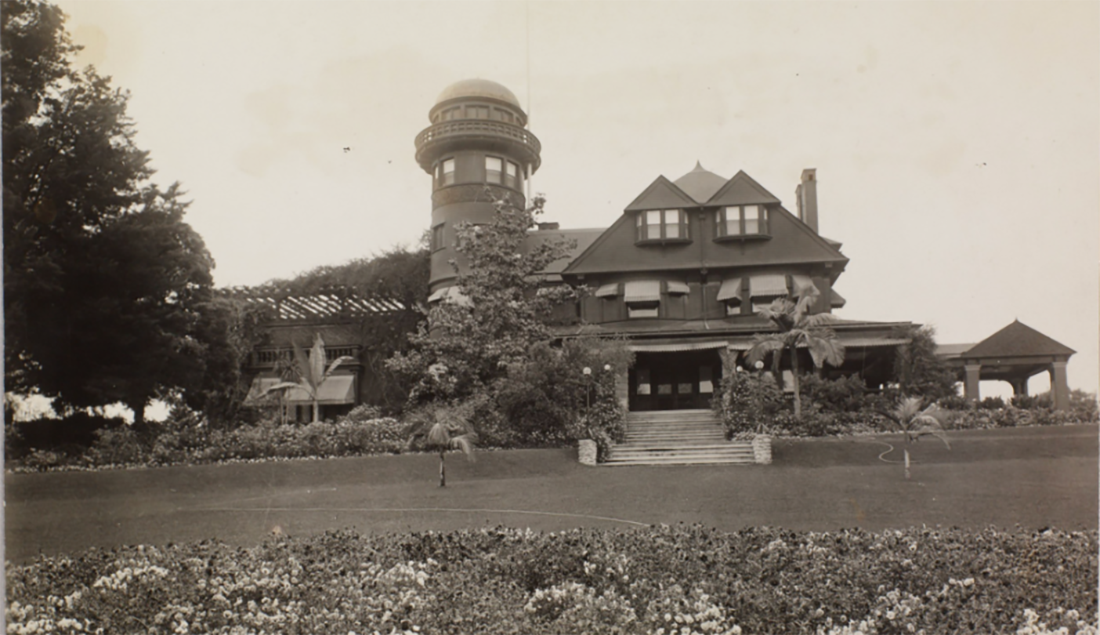
For a few years around the turn of the century, Barak and Libbie Pierson raised their family in a forty-room mansion.
Barak had spent over a decade working as a carpenter in North Pasadena when, in 1899 or 1900, he was hired as caretaker of a nearby estate on South Orange Grove Avenue. Its owner, the inventor and balloonist Thaddeus Lowe, had poured his fortune into an ambitious scenic railway up the mountains above Altadena. The railway failed, and after a bitter legal fight, the mansion itself was sold out from under him. Granddaughter Beth Page remembered that her grandfather “was working for a Mr. Lockwood, who was the executor of an estate,” and that Lockwood asked Barak to move in.
Barak and Libbie’s three children lived at the mansion too, at times alongside Barak’s mother Deborah and Libbie’s father John. They used only a portion of the house. The children turned the empty rooms into a playground. Beth called it “a great place for teenagers to live.”
Their son George, around thirteen by the 1900 census, helped his father tend the estate’s tropical plants. Rena, George’s future wife, recorded that Barak “trained George to assist in their care.” George cut the long stems of the estate’s Bird of Paradise flowers, tied them into bunches, and pedaled them by bicycle to a nearby hotel’s back door, selling them for twenty-five cents a bloom.
Deborah, sixty-eight, wrote to a niece describing her own corner of the arrangement, three rooms of her own: “I have a Gasolen stove and cook my own board and do all my own work. As long as I am able I prefer to wait on my self allthough my children think I had not aught to do it and Ella is not reconsiled about my keeping hous.” In 1902, Libbie’s father John died at the mansion.
By 1905 the family was back at a house at Kenyon and Kirkwood in North Pasadena. In 1910 they left Pasadena for good, for an orange ranch in Orosi. The mansion eventually became part of Busch Gardens, a public attraction, before being subdivided and, by the 1950s, replaced by apartments. In May 2025, Laura Atkins, Barak and Libbie’s great-great-granddaughter, drove out with her partner Mitch to find where it once stood. When they located the spot, Mitch realized he had once lived in an apartment built on that exact ground.
[Pull-out box]
Lockwood or Torrance?
How Barak came to the job isn’t fully settled. Beth’s account names Lockwood. Clarance Smith has proposed another possibility, drawing on the family’s letters and old Erie County land maps. Jared Sidney Torrance, later appointed receiver of Lowe’s bankrupt railway, grew up on land in Gowanda, New York adjoining William R. Pierson’s own property. The city of Torrance, California is named for him. Decades later, the families’ paths crossed again in Pasadena. In 1888, Barak’s cousin William Strang wrote home describing an elderly Judge Torrance, “very feeble” and dying of consumption, living there with his son. That son was Jared Sidney Torrance himself. Lockwood or Torrance, or perhaps both, working through this same tight-knit community.
Sources
This entry draws on the 1900 U.S. Census; Beth Page’s recorded oral autobiography; the Ahnentafel Chart for George Mercer Pierson, written by Rena Pearl [Waltz] Pierson; Deborah Chickering [Smith] Pierson’s September 2, 1900 letter to a niece; William Gabriel Strang’s March 16, 1888 letter to his father, Ryal Strang; and city directory, newspaper, and land record research compiled by Laura Atkins, Clarance Smith, and Vic Lewis. All of these documents, along with additional photographs and detail, are presented in full in the dive version of this story.